Water first
Find out where the water comes from before you cover anything. A basement finished over an unsolved water problem is the most expensive kind of basement to repair.
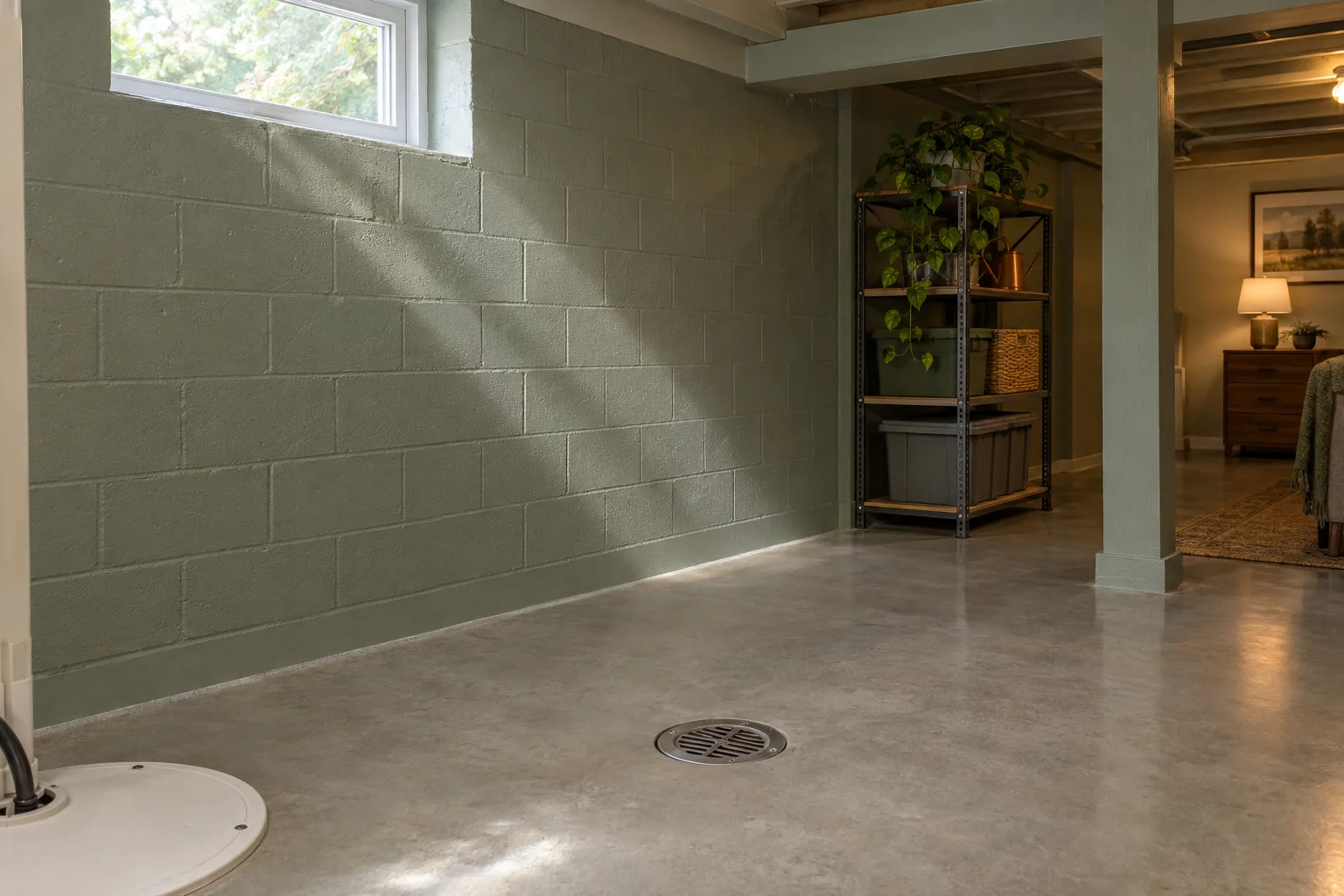
Water in a basement comes from three places: the ground around the foundation, the sewer or drain line, and the air inside the room. They look alike on a wall and are fixed in very different ways, which is why the first job is to tell them apart.
Reading the signs
| What you see | What it may mean | First step |
|---|---|---|
| White powder on masonry or concrete | Water has moved through the wall and evaporated, leaving mineral salts behind | Photograph it before cleaning; note which walls and how high |
| Stained or peeling paint, a damp patch | Moisture is moving through the wall, or condensation is forming on it | Do the foil test below |
| A musty smell after rain | Moisture is reaching something organic: wood, cardboard, paper-faced board or carpet | Find where it is strongest; look behind stored boxes |
| Rust at the base of steel posts, furnace feet or a water heater | Water has stood on the floor at some point | Ask when it happened and how deep it was |
| A damp line where the wall meets the floor | Water pressure under the slab, or a leak at the joint | Note whether it appears only after heavy rain |
| Horizontal or stair-step cracks in masonry walls | The wall may be under pressure from soil and water outside | Do not patch it; have a structural engineer look at it before it is covered |
| Black, green or fuzzy growth on walls or stored items | Mold grows where materials stay damp; it is a symptom of moisture, not the cause | Fix the moisture source first; large areas or health concerns call for a professional assessment |
| Water from the floor drain or a toilet during a storm | A sewer backup, not seepage | See our page on sewer backup and flood control |
The foil test: is it a leak or condensation?
Tape a square of kitchen foil flat against a damp-looking wall, sealing all four edges, and leave it for a day or two. If moisture beads on the outside of the foil, it is condensation: humid room air meeting a cold wall. If the wall behind the foil is wet, moisture is coming through. It is a rough check: a dry result does not rule out a leak that only shows in storms, and it does not replace a proper look. It separates two problems that are fixed very differently.
Not sure what applies to your house?
Send photos of your basement with an estimate request, or call 847.962.4689. Robert will tell you what he would look at first.
Outside the wall comes first
Often the first step, and sometimes the least costly, is outside the wall. Gutters that are full, downspouts that empty beside the foundation and soil that slopes toward the house all send water to the wall. The City of Chicago recommends disconnecting downspouts from the drainage system, partly to reduce the load on the sewers during intense storms. Extend downspouts well away from the foundation rather than just disconnecting them. Window wells that fill with leaves and water are another route in.
Do not let a deadline rush a diagnosis
Waterproofing is a field in which homeowners often describe feeling pushed: a large bill, a system sized for the worst case, an offer that expires when the salesperson leaves. Whoever you hire, ask for the diagnosis in writing: where the water is entering, why they think so, and what each part of the proposal does about it. Get the same question answered by more than one person if the cost is large. A proposal that must be signed today is a reason to wait.
How we handle it
Robert notes what he sees at the walk-through and prices moisture work as separate lines, so you can see what water costs on its own and decide about it separately from the finishing.
Only then, the finish
Once the water is understood, the wall and floor are built to tolerate what is left: moisture-tolerant materials against the foundation, a floor that does not trap vapor and a way to reach the drain. See our pages on walls and on flooring.
Read next: Walls and insulation · Flooring · Sewer backup and flood control
Questions
Can I paint the wall with a waterproofing paint?
A coating can hide the signs without stopping the water, and moisture trapped behind it can lift it. It is not a fix for a leak.
Does a dehumidifier solve a wet basement?
It can help with damp air and condensation. It does not stop water entering through the wall or floor.
Should I fix water before or after I finish?
Before. Water problems found after the walls are up cost more to reach and repair.
Homes where this comes up
Keep reading
- Sewer backup and flood control
- Walls, insulation and air
- Basement flooring
- Questions to ask before you sign
Sources checked
Checked November 5, 2026. Codes and programs change. Check the current rule with your city or village before you rely on it.
Tell Robert about your project.
Call, email or send an estimate request with photos. You deal directly with the person running your job. Robert replies within 2 business days.